Find inspiration, gain knowledge, and achieve your fitness goals.

Our Episode

N/A

Show Notes

Are you overwhelmed by stress and seeking immediate relief without stepping away from your hectic life?

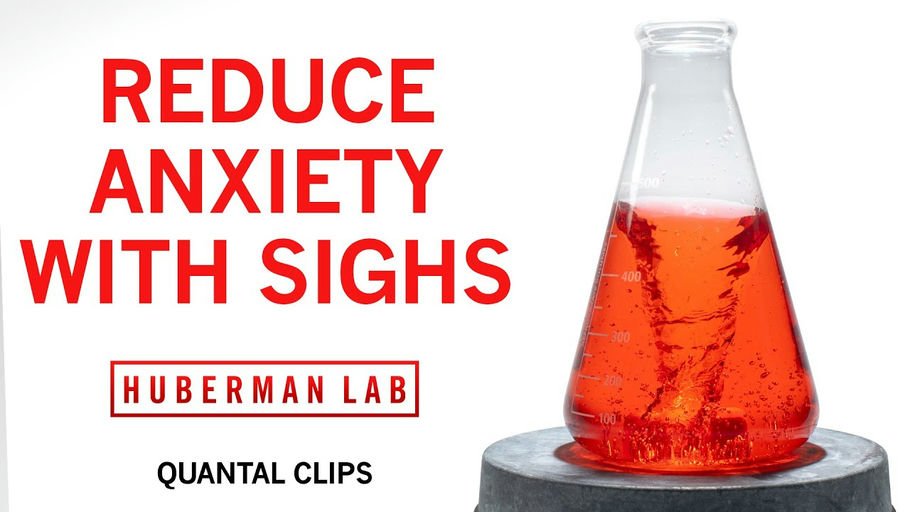
In a world where stress is omnipresent, Andrew Huberman, a renowned neuroscientist, offers a revolutionary solution: the physiological sigh. This simple yet powerful technique allows you to achieve calmness without the need to disconnect from the stressors in your life【4:0†source】.

The physiological sigh is a breathing pattern involving two consecutive inhales followed by an extended exhale. It mirrors the natural response our bodies have when we encounter high levels of carbon dioxide in our bloodstream – a signal that’s typically under unconscious control【4:0†source】.

Discovered in the 1930s, this breathing tactic is a natural mechanism acting to recalibrate our internal state. Our lungs, with millions of tiny sacs designed to optimize oxygen intake and carbon dioxide offload, benefit greatly from this method. By reinflating collapsed sacs during the double inhale, you enable greater offload of carbon dioxide, effectively bringing a sense of calm【4:0†source】.

Practicing the physiological sigh is accessible and immediate. Ideally performed through the nose for the inhales and the mouth for the exhale, it promises near-instant anxiety relief. If nasal breathing is not feasible, simply adjust to what feels comfortable and effective【4:0†source】.

In real-world scenarios, envision yourself in a tense meeting or caught in traffic. Instead of allowing stress to build, utilize the physiological sigh right then and there. You take a deeper breath, then a shorter one, and complete with a prolonged exhale. Within moments, you’re likely to notice a decline in stress and a simultaneous rise in composure【4:0†source】.

This technique, often overlooked in favor of more elaborate stress-management strategies such as meditation and therapy, stands out as it demands nothing but a few seconds of your time and zero separation from the tasks at hand. As the simplicity of the technique appeals, its effectiveness continues to be supported by scientific research【4:0†source】.

In summary, the physiological sigh is an efficient tool for stress reduction that everyone should be equipped with. Andrew Huberman’s insights illuminate its potential to reform individual stress management, making it indispensable for modern-day living【4:0†source】.

Products Mentioned In This Episode

No related products found.

Key Takeaways

  • Physiological Sigh Technique**: A practical breathing pattern involving two consecutive inhales followed by a long exhale to reduce stress quickly【4:0†source】.
  • – **Immediate Stress Relief**: Practice the physiological sigh in real-time without needing to remove yourself from stress-inducing situations【4:0†source】.
  • – **Neuroscientific Basis**: Explains the body’s natural response to high carbon dioxide levels, which can be leveraged voluntarily for calming effects【4:0†source】.
  • – **Simplicity and Accessibility**: The method requires no special equipment and can be executed in any setting【4:0†source】.
  • – **Enhanced Breathing Efficiency**: The double inhale reinflates lung sacs, facilitating better oxygen intake and carbon dioxide offload【4:0†source】.

[dramatic music]
– Billions of people suffer from stress
and there are tools to combat
stress that involve things
like meditation, breath
work, good nutrition,
good social connections
and avoiding all bad things in life.

And while those are
powerful, the problem is,
they require that people step away
from the stress inducing activity.

By contrast, my lab and other laboratories
have been very interested
in developing tools that allow
us to push back on stress.

In other words, feel
more calm in real time,
meaning without having to disengage
from the stress inducing activity.

The best way that I am aware to do that
is called the physiological sigh.

A physiological sigh is
a pattern of breathing
that involves two inhales
followed by an extended exhale.

Physiological sighs were
discovered in the 1930s,
as a pattern of breathing
that people go into spontaneously
when they’re in
claustrophobic environments
or in deep sleep, when there’s a buildup
of a gas called carbon
dioxide in the blood stream.

Carbon dioxide triggers
the impulse to breathe.

There are neurons in the brain that know
when carbon dioxide levels
have gotten too high.

And when the levels get too high,
they trigger inhale and exhale,
or double inhale and exhale.

Now you can do physiological
sighs voluntarily,
anytime you’re feeling too stressed
and you want to feel more calm.

You do it like this.
[breathing]
So it’s a double inhale.

And typically, the first inhale
is longer than the second
but the second one is
still important to do.

And then a very long, extended exhale.

Typically, both inhales
are through the nose
and the exhale is through the mouth.

That’s the most effective way
to do the physiological sigh.

However, you can’t
breathe through your nose
or your mouth for whatever reason
do it all through your mouth
or all through your nose.

The second inhale is really important
because your lungs are not
just two big bags of air.

They’re two big bags of air
with lots of little
sacks, millions of sacks.

And if you were to lay out those sacks,
their volume is as big as a tennis court.

And that allows both the
intake of more oxygen
but also the offload of carbon dioxide.

So when you do the double
inhale, it reinflates
any of these little
sacks that have collapsed
and in doing so, it allows you
to offload more carbon dioxide.

So if you’re feeling
stressed in any circumstance,
inhale twice through the
nose and then exhale long
through the mouth, if you want,
you can repeat it a second
or even a third time, but
typically, just one or two,
maybe three physiological sighs
are sufficient to bring
your level of stress
and alertness down very fast
and allow you to feel more calm.

Watch Now

Listen Now

N/A

MORE PODCASTS

SIGN UP TO THE FITPOD NEWSLETTER

Products

New Episodes