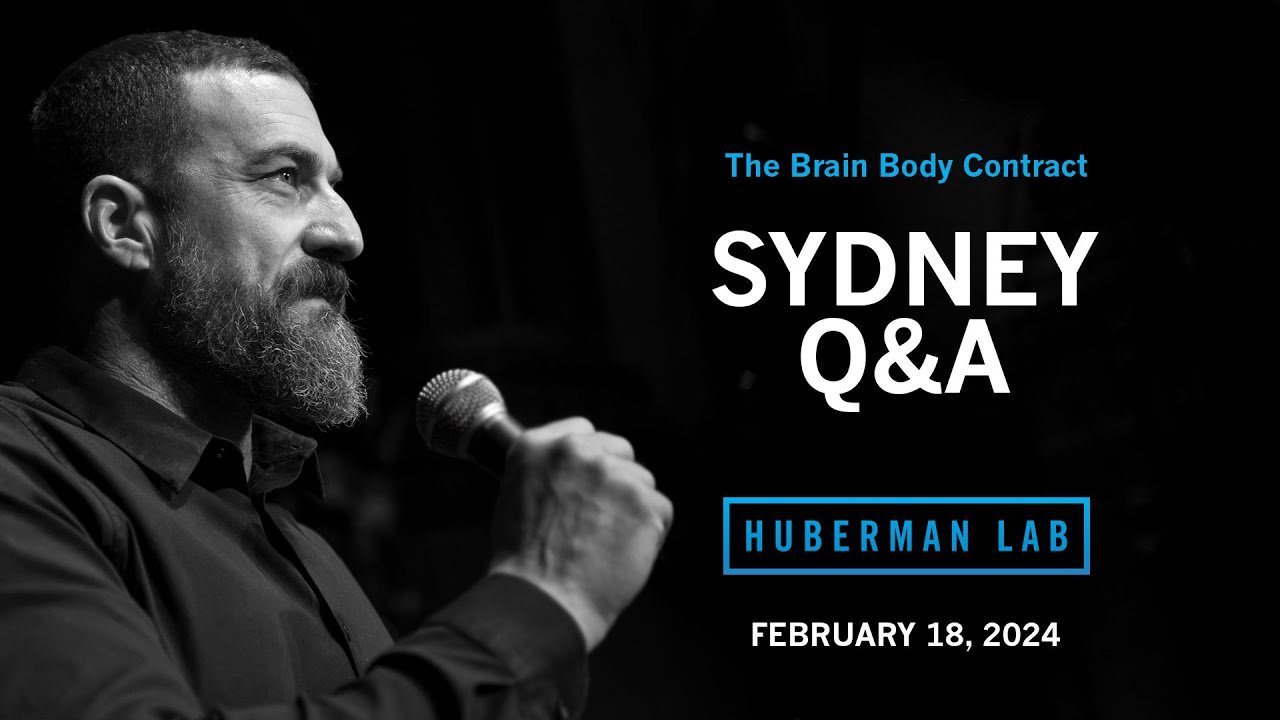
Dr. Andrew Huberman shares intriguing insights on the gut-brain axis, sleep science, and the potential of psychedelics in a captivating live discussion.
The episode opens up with a focus on the gut-brain connection, where Dr. Huberman emphasizes the importance of a diverse microbiome. He explains that gut health plays a crucial role in mental health and performance. The key takeaway is to incorporate fermented foods like kimchi or kefir into your diet, which supports microbiota diversity essential for neurotransmitter production and overall cognitive function.
Moving onto brain health strategies, Huberman highlights the importance of focusing techniques. He suggests creating an environment conducive to concentration—free from distractions like phones can significantly enhance one’s capacity to focus. He elaborates that training the focus muscle isn’t an instantaneous process; much like physical exercise, cognitive focus requires persistent practice and gradual progress.
Huberman’s exploration of psychedelics introduces a transformative perspective on mental health treatment. With a focus on psilocybin and MDMA, he explains how these substances, under clinical settings, can drastically improve conditions like PTSD by enhancing neural connectivity and empathy. The discussion underscores the potential of such compounds for therapeutic uses, while also advocating for responsible and supervised applications.
The episode also deep dives into sleep science, unraveling the critical role that sleep patterns play in physical and mental health. Huberman insists on maintaining sleep regularity that aligns with one’s chronotype; whether you’re an early bird or night owl, consistency in your sleep schedule optimizes mental acuity and overall health.
Wrapping up with a practical approach to personal development, Huberman shares insights into neuroplasticity, advocating that cognitive learning improves with strategic difficulty – balancing tasks so they’re challenging enough to stimulate growth without overwhelming the learner. This ideology mirrors resistance training principles, where progressive challenges lead to effective long-term adaptations.
Ultimately, Dr. Huberman’s lively discourse is more than just information; it’s a compelling invite to rethink and retool your approach to brain health.
No related products found.
welcome to the huberman Lab podcast
where we discuss science and
science-based tools for everyday
[Music]
life I'm Andrew huberman and I'm a
professor of neurobiology and
Opthalmology at Stanford School of
Medicine recently the hubman Lab podcast
hosted a live event at the ICC theater
in Sydney Australia the event was called
the brain body contract and featured a
lecture followed by a question and
answer session with the audience we
wanted to make the question and answer
session available to every one
regardless if you could attend I also
would like to thank the sponsors for the
event they are eight sleep and ag1 eight
sleep makes Smart mattress covers with
cooling Heating and sleep tracking
capacity now I've spoken many times
before on this podcast about the fact
that sleep is the critical foundation
for mental health physical health and
performance now one of the key things to
getting the best possible night sleep is
to control the temperature of your
sleeping environment and that's because
in order to fall and stay deeply asleep
your body temperature actually needs to
drop by about 1 to 3° and in order order
to wake up feeling refreshed and alert
your body temperature actually has to
increase by about 1 to 3° eight sleep
mattress covers make it extremely easy
to control the temperature of your
sleeping environment and thereby to
control your core body temperature so
that you fall and stay deeply asleep and
wake up feeling your absolute best I've
been sleeping on an eights Sleep
mattress cover for about 3 years now and
it has completely transformed the
quality of my sleep for the better eight
sleep recently launched their newest
generation of pod cover the Pod 4 ultra
the Pod 4 cover has improved cooling and
heating capacity higher Fidelity sleep
tracking technology and the Pod 4 cover
has snoring detection that will
automatically lift your head a few
degrees to improve airflow and stop your
snoring if you'd like to try an eights
Sleep mattress cover you can go to
8sleep.com
huberman to save $350 off their pod 4
ultra eight sleep currently ships to the
USA Canada UK select countries in the EU
and Australia again that's 8sleep.com
huberman the other live event sponsor
ag1 is a vitamin mineral probiotic drink
that also contains adaptogens and other
critical micronutrients I've been taking
ag1 daily since 2012 so I'm delighted
that they decided to sponsor the live
event I started taking ag1 and I still
take ag1 once or twice a day because it
gives me vitamins and minerals that I
might not be getting enough of from
Whole Foods that I eat as well as
adaptogens and micronutrients those
adaptogens and micronutrients are really
critical because even though I strive to
eat most of my foods from unprocessed or
minimally processed Whole Foods it's
it's often hard to do so especially when
I'm traveling and especially when I'm
busy so by drinking a packet of ag1 in
the morning and often times also again
in the afternoon or evening I'm ensuring
that I'm getting everything I need I'm
covering all of my foundational
nutritional needs and I like so many
other people that take ag1 regularly
just report feeling better and that
shouldn't be surprising because it
supports gut health and of course gut
health supports immune system health and
brain health and it's supporting a ton
of different cellular and organ
processes that all interact with one
another other so while certain
supplements are really directed towards
one specific outcome like sleeping
better or being more alert ag1 really is
foundational nutritional support it's
really designed to support all of the
systems of your brain and body that
relate to mental health and physical
health if you'd like to try ag1 you can
go to drink a1.com huberman to claim a
special offer they'll give you five free
travel packs with your order plus a year
supply of vitamin D3 K2 again that's
drink a1.com huberman
and now for the live event at the ICC
theater in Sydney
[Music]
[Applause]
[Music]
Australia does having an afternoon sleep
affect your quality of sleep at night um
great question I can keep this one
pretty brief um we just recorded a six
episode series that will be aired later
this year uh with the one and only
Mighty Matt Walker who wrote The
Marvelous book why we sleep and uh we
went into this topic in depth the
business of naps is the following keep
them shorter than 90 minutes so you
don't disrupt your nighttime sleep don't
do them at all if it disrupts your
nighttime sleep so if you're somebody
that for whom even 10 minutes of napping
disrupts your nighttime sleep don't do
that
if you're somebody who wakes up from
naps feeling groggy that's what's called
Sleep inertia this is what gave rise to
the ever famous napino of having some
coffee and then taking a nap or an
espresso and then taking a nap again I
get obsessed with gnomen clature why
didn't they call it a Espress espresso
nap I don't know
naps are wonderful if they're shorter
than 90 minutes don't interfere with
nighttime sleep but I in particular am a
big fan of as many of you know this
business of non-sleep deep rest of
putting the body into what body still
mind awake and we know based on several
studies from the University of
Copenhagen that that actually
replenishes levels of dopamine in
certain key areas of the brain that
restore mental and physical
Vigor and do not disrupt nighttime sleep
but rather enhance one's ability to fall
and stay asleep or to fall back asleep
so not only are these states of body
still mind
awake very beneficial it seems or I
should say perhaps for creativity
because that was all anak data but we
know from real data from laboratory data
on many subjects peer-reviewed Etc that
body still mind alert is actually an
effective means to improve one's sleep
and perhaps even make up for sleep that
one has lost so I encourage you if
you're a napper great and if you have
challenges with sleep in any way that
you think might be related to your
napping activity that you consider short
10minute or maybe 20 minute non-sleep
deep breast protocols by the way they're
completely zero cost and very soon we
will be releasing to our YouTube clips
Channel a 10minute 20 minute and 30
minute non-sleep deep rest protocol that
I've narrated if you don't like my voice
we can there are many out there of more
pleasant voices but um what might be of
particular interest to you is that the
visual is of um the beautiful sunrise
over Sydney so you know it'll bring you
home as well um sunrises here absolutely
spectacular do you believe in the
placebo effect absolutely and there's
probably a joke there but I can't come
up with it on the Fly um how would I
know if it's real that um something like
that um so the placebo effect is real um
our belief about what we've taken or
what is happening to us has a powerful
effect on our physiology it's not purely
psychological the whole business of
psychosomatic even that word is starting
to fall away as we start to understand
that our beliefs have a powerful effect
on what happens to us physiologically so
much so that for instance my colleague
Ali
Crum a tenar professor at Stanford's
Department of psychology who's been a
guest on the podcast who studies
mindsets has done beautiful experiments
on stress showing that if you watch a
short video about stress and you learn
all the terrible things that stress can
do to your cognition your sleep and your
well-being well that indeed that happens
and that if you watch a short video
about how stress can be performance-
enhancing by sharpening your mental
acuity your access to
particular memory stores Etc that indeed
that happens so-called belief effects
why belief effects not Placebo effects
well Placebo effects tend to be more
General belief effects tend to be around
specific types of information but the
placebo effect has recently been shown
to extend to a dose dependent placebo
effect one of the more remarkable papers
I think published in the last few years
most people are unaware of I talked
about this in a journal Club episode of
The hubman Lab podcast with the one and
only Peter
Atia described a paper where people took
either zero I believe it was
.25 milligrams half a milligram or a
gram of nicotine which is known to be a
cognitive enhancer please don't smoke
dip Huffer snuff nicotine that's erous
in those forms but and taking nicotine
can increase blood pressure Vasa
constriction Etc but nicotine is a
cognitive enhancer it is a cognitive
enhancer and I can't help but tell you
one story about this before I get back
to placebo effect don't worry I always
make my way
back you can see why living with me as a
child was so challenging
um nicotine I was told by a very very
famous Nobel laurate member M of the
Neuroscience Community because I visited
his office I won't tell you who it is at
Columbia University I met with him and
he was telling me about what he studies
but I noed he chewed no fewer than six
pieces of Nicorette during the course of
that conversation and I had to just stop
him at one point and say why are you
consuming all this nicotine and he said
well it's what's going to allow me to
saave off Parkinson's and Alzheimer's of
course and I don't want to smoke and I
said really and he said yeah there's
some evidence that keeping levels of
neuromodulators like dopamine
acetylcholine elevated despite the
increases in blood pressure that are
caused by consuming nicotine May indeed
offset Parkinson's and Alzheimer's I'm
not telling you this as a clinical trial
I'm telling you this as anic data he is
a Nobel Prize winner he's still very
very sharp in his 80s the point here is
that in a study of nicotine and
cognition where people's cognition is
indeed enhanced by nicotine everybody
knows that and agrees upon that people
who were told they had a higher dose of
nicotine performed better in this
cognitive task when in fact they
consumed
zero and people who performed
moderately who were then told that they
had consumed a higher dose of nicotine
performed better than those that simply
consumed the moderate dose and were told
they had a moderate dose in other words
everyone gets the same dose either zero
or moderate but depending on what you're
told your performance changes
accordingly and that's cool but what's
really cool about the study is they
actually recorded from brain centers of
these individuals and the levels of
activity in particular areas of the
brain that are relevant for cognition
changed according to what the people
believe so there you go placebo effect
is changing neural activity it's not all
just through what you think is happening
what you think is happening is the
reflection of neural activity and then
you go well of course but I think it's
an important study so I believe in the
placebo effect and it is dose dependent
and that raises all sorts of scary
concerns about the placebo effect but
it's also pretty darn cool because what
it means is that our belief system
including our understanding of the
mechanisms that are likely driving
certain effects of drugs or protocols or
what have you is going to play a
powerful role in whether or not we get
the effect that we want and perhaps
that's the most important thing provided
that you're going about it
safely how do I enter the rest and
digest State and exit my constant fight
ORF flight State well the fastest way is
going to be physiological size probably
repeated two or three times in a row if
you don't experience that the first time
the second would be to combine that with
panoramic Vision I must say and I don't
want to sound like a like a repeating
record here but there are certain things
that if we're not doing on a regular
basis our nervous system is just going
to idle at a higher let's just call it
autonomic RPM which is not you know real
science language but if you've ever felt
kind of wired and tired from lack of
sleep you know what this is about the
key thing is to get enough sleep each
night you know so much so that I think
we can safely say that stress is not bad
for us provided you sleep well at night
now the challenge is for most people
including myself if you stress a lot
sleep doesn't come easily or you wake
from sleep in the middle of the night
and here again is where zero cost
behavioral protocols are truly in my
opinion unless there's some dire
clinical
need the most effective and best
practice and this non-sleep deep rest
which by the way is indeed a renaming or
a partial renaming of Yoga Nidra which
stands for yoga sleep and again I have
tremendous reverence for the yogic
Traditions it's just that I had to make
a decision a few years ago when I'd been
introduced to yoga Nedra in 2015 I was
down at a trauma Treatment Center an
addiction treatment Center in Florida
run by a friend of mine essentially
observing what they were doing with
these addicts That Couldn't recover no
matter what their effort and they were
able to recover to get sober and stay
sober and people were getting over other
sorts of traumas through the use of many
Protocols of course talk therapy Etc but
they would start their day with 30
minutes to an hour of yoga NRA and I
thought what's Yoga Nidra ex learned its
yoga sleep you lie down you do a
self-directed relaxation it also
involves intentions Etc and I thought
this is really powerful and I spent a
lot of time in my laboratory working on
it and understanding it and there are
other studies as well that now explain
how these states of keeping the Mind
active while the body is still as a
self-directed practice is immensely
powerful for a number of reasons and the
reason I decide to call it non-sleep
deep rest
nsdr was not to rob it of the official
name of yoganidra but because
unfortunately
unfortunately names like yoganidra
or proprietary names or thing when we
name protocols after
people it acts as a separator it often
deters people from trying things because
it sounds esoteric so I went with a
description of the
thing that relates to what the thing is
supposed to do non-sleep deep rest or
what it's all about so um you know I
actively avoided calling it huberman
breathing um or something like that
because that's not my interest my
interest is in people using these tools
and I have taken some heat for that one
um I'm not interested it was not an
attempt to appropriate something it was
really an attempt to just try and
distribute valuable tools because I see
a lot of suffering and it seems like a
useful thing to do so I would encourage
anyone that feels like they enter a
stressed State too much to learn
self-directed relaxation first and
foremost so do nsdr anywhere from three
to five times a week 10 minutes a day as
a zero cost tool as a way to be able to
better access better sleep at night and
then if the figh ORF flight State
persists then of course things like
physiological size Etc um should be
incorporated and then of course of
course of course I believe in modern
medicine there are excellent
pharmaceutical tools prescription drugs
that can be used for that but of course
there's the intermediate stuff things
like theanine and magnesium that you
know for all the world can be useful in
some context but they're not the be all
end all you know as much as I might
reference supplements on the podcast
from time to time I don't think they're
the place to start I think one should
always use behavioral tools first and
I've said this many times before um but
I think it's worth saying again our
muscles need rest days from the gym in
order to grow back stronger yes
definitely true um is the brain designed
to be consistently learning and
developing or does does it need periods
of rest from consuming new information
or is the rest when we sleep great
questions thank you Timothy um yes
indeed our
muscles get stronger grow after a proper
stimulus is applied to them in the time
after we provide that stimulus which
typically is resistance but since not
everyone's interested in that it's also
the case that an endurance
adaptation
occurs after we embark on the run the
hike the swim Etc there's something kind
of interesting and I just want to take a
moment and just um mention that there's
something kind of interesting about
resistance training is that the one form
of training that because of the enhanced
blood flow to the muscles while we do it
gives us a window into what the
adaptation might look
like once it occurs if we allow proper
rest whereas with endurance training
it's very different right you go further
and or you run up a hill until your legs
burn and you want to vomit up a and then
the next time you do it you don't feel
quite as bad right the adaptation occurs
of course in a very similar way to
resistance training different mechanisms
but there's a delay and adaptation you
get better it's just that with
resistance training you can kind of
sense the change before the change
occurs because of the enhanced blood
flow of the muscles with endurance
training you sense the limit of your
ability and then you exceed that limit
subsequently now in terms of cognitive
learning the same thing is basically
true if you want to get really technical
about it the computational biology the
modeling of this says that if you want
to learn something probably setting the
difficulty of what you're trying to
learn to about 85% correct trials 15%
error trials is probably ideal what does
that mean it means if you're trying to
learn a new piano piece you know or
you're trying to teach that to a child
if they're not starting from scratch let
them play something that they know
pretty well and then introduce a small
percentage maybe 10 to 15 maybe 20% you
don't have to be exact about this of
Novel material that's hard for them to
learn but yes it is the focused
deliberate attempt to learn something
that creates that sense of underlying
agitation that is the trigger the
stimulus for
neuroplasticity this makes sense if you
could complete something if you could do
something a scale on of Music a physical
task speaking a new language if you
could do that why would your nervous
system ever change and how does your
nervous system know if it's supposed to
change right your nervous system doesn't
know successful trial versus failure
trial right I've tried many times to
learn other languages and I'm you know
modestly terrible at Spanish but if I
were to try and get better my nervous
system doesn't know when I'm failing has
no idea what it knows is the release of
certain neurom
modulators namely adrenaline and
norepinephrine and a few others as well
that are associated with the underlying
agitation of like I'm failing at this
I'm not able to remember that Spanish
class because I didn't attend in high
school and this is really difficult and
that agitation the frustration is the
stimulus but when we say frustration
it's the neurochemicals that when they
bathe the surrounding neurons those
neurons go oh something needs to change
for next time and lo and behold the
stimulus for neuroplasticity has
occurred but the actual rewiring of the
neurons either the Improvement or the
reduction in the strength of synapsis of
connections between neurons and in rare
instances the addition of new neurons
for neuroplasticity occurs yes when we
sleep in states of deep rest or
non-sleep deep rest although there's
less data to support that but the actual
rewiring occurs away from the stimulus
so there's really two important
principles here one is that agitation
and stress and the neurochemicals that
underly agitation and stress that is the
stimulus for Learning and goodness do I
wish they had taught me that in school I
mean they taught me all sorts of things
in school but they didn't teach me that
they didn't teach me the physiological
side Lord knows I would have done better
in life if I had those tools instead
they told me look you know if you drive
drunk you could die that was good
information but they didn't tell us
about all the other stuff so I wish they
told us about the stimulus and rest
thing and somehow they have permission
to talk about the rest all right what's
my take on
hallucinations goodness gracious my take
on
hallucinations is um I've taken them um
clearly um well here's the the real
story on Hallin first of all um I'm I'm
very open about most everything I've
done you know um trying to keep context
appropriate but um I I had the
unfortunate experience of taking LSD and
Sil sibin when I was all too young and
those were bad experiences some of them
were bad in the moment some of them were
bad after the moment it is something I
do not recommend and I'm not saying that
to be politically correct I'm not saying
that because it's true the reality is
that being a child an adolescent or a
teenager is ay psychedelic
experience and your brain is still
wiring up in all sorts of interesting
ways and everything seems chaotic and
even if you're one of those rare kids
that seems to have everything roded up
appropriately you don't want to throw
massive amounts of neuromodulators in
there haphazardly and start tampering
with the wiring that's my deep belief
okay you that's my deep
belief however
it does appear that at least for adults
who are not suffering from particular
psychiatric challenges namely forms of
psychosis right this is real I mean one
in 100 people experiences schizophrenic
symptoms Etc it's a very high number if
you think about it um certain forms of
bipolar depression that the clinical
trials on psychedelics and here I'm
assuming when you say hallucinogens
you're referring to psychedelics are
very very compelling the psychiatric
Community is now being forced to look at
these data because the data are very
compelling what do we know about these
data and yes I've participated in two
such clinical trials one on high do
psilocybin high dose meaning more than
two grams taken twice by the way this is
with the support of medically trained
therapists and the use of psychedelics
such as psilocybin mostly psilocybin not
so much LSD do you know why most of the
trials are on psilocybin and not LSD I
do but I'm curious if you know it's not
to what's that LSD is too long that's
right that people need to go
home people need to go home the
technicians need to go and LSD is a long
ride it's a long ride so the the thing
about cybin is that the you know the
sort of Journey the trip is you know
somewhere on the order of anywhere from
you know 3 to 7 hours which can fit into
a reason able work day for a technician
clinician um and LSD can be many many
hours longer the kind of um Mount
Everest of psychedelics which is under
investigation by a colleague of mine at
Stanford School of Medicine Nolan
Williams is ibigan iboga which is 22
hours long it has cardiac effects this
is not something to to get Cavalier with
this is something only to be done in a
clinical context with medical experts
there and iboga is very interesting from
what I'm told I have not participated in
iboga trial iboga allows for or induces
a state in which you do not hallucinate
at all with eyes open but the moment you
go eyes closed you get a
highresolution
accurate picture of Prior events in your
life but you have agency you have
volition inside of those pictures and
you're able to change your behavior and
resculpt your Rel relationship to those
experiences like wow and the state of
Kentucky in California recently excuse
me the state of Kentucky in the United
States thank goodness Kentucky isn't
inside of California that would be civil
war the state of Kentucky recently took
the $40 million settlement from the
opioid thing right you've all heard
about that the opioid crisis and applied
that money to iboga trials so this stuff
is happening this stuff is really
happening now in the US in any event
psilocybin these two
sessions medically supported two
sessions um has been shown to be pretty
effective in the treatment of major
depression not completely effective
sometimes there's adverse outcomes but
far more effective than the other
pharmaceutical treatments that it's been
compared to so that's interesting and
psilocybin is serotonin if you look at
the structure of psilocybin and it looks
like serotonin so we're talking about is
a massive dose of
Serotonin and psilocybin appears to bind
near selectively to a particular
serotonin receptor and the outcome seems
to be enhanced or more more broad
connectivity between brain areas that
normally are not communicating with one
another probably not the growth of new
connections but the let's say the
unveiling of the ability for certain
brain areas to communicate with with one
another whereas they couldn't prior
different ways of thinking about the
same problems which is logically sound
if you think about ways to deal with
depression depression is characterized
by a number of things of course but one
of the Hallmark features of depression
in addition to sleep challenges is a
lack of positive anticipation of the
future and it does seem that these macro
do cocin trials are helpful for that
turns out that the micro doing of
psilocybin has not been shown to be
Terri effective which is not to say it
isn't but the trials don't support that
although there aren't many Trials of
that yet so it appears you know if you
had to pick between micro and macro
dosing go
macro um but be careful um go be careful
and and set in setting is important
safety is important and certainly not
for children and as long as and or
adolescence or teenagers I really again
want to want to reemphasize that the the
other thing is as long as we're talking
psychedelics and hallucinogens we should
probably just touch on MDMA for a moment
first of all MDMA ecstasy um has a
number of challenges or potential
problems that need to be highlighted
first of all um contaminants you know we
have a fentanyl crisis in the US so
contaminants so Purity is essential
second of all it is methylene dioxy
methampetamine
and the methamphetamine part often gets
people thinking like whoa it seems
however that the inclusion of the
methylene dioxy component increases
serotonin dramatically and it is the
increase in
serotonin perhaps or at least it's now
thought in addition to the increase in
dopamine caused by the methampetamine
component combined that provides some
sort of neuroprotective effect the early
reports that MDMA ecstasy is neurotoxic
quote unquote puts holes in your
brain was flawed by and indeed that
paper was retracted the researchers did
that study in Earnest but then later
discovered that when they reached for
the MDMA on the Shelf they actually
grabbed the
methamphetamine but the news agencies
didn't report that retraction now our
best evidence that
MDMA taken in the appropriate clinically
supported context can act as an
empathogen can help people develop
empathy for themselves and help relieve
trauma and indeed the clinical trials
show that at the proper dosing and the
proper frequency with the proper support
there's up to 60% and as high as 67%
remission of PTSD
remarkable with support okay not just
taking Molly and like dancing in the
desert we're talking about we're talking
about in the eye mask we're talking
about going inward we're talking about
relaying your experience we're talking
about talking about the challenging
experience or experiences with someone
who's qualified to help you deal with
all of that Etc and someone to drive you
home because you feel like a puddle
afterwards talking about all of that
we're not talking about eye gazing with
your partner telling them how much you
love them you're talking about empathy
for self love for self which is a
concept that frankly I've often
struggled with I thought you know people
would say you got to love yourself I'm
like what is that like what is that I
love my Bulldog I love my friends I love
cuttlefish but like what is that and I
think through the use of MDMA you can
there seems to be this ability to
develop imp pathogenic states to
yourself but of course the reason for
the clinical trials insisting that
people stay in the IM askk and
communicate their experience maybe
popping out of it every once in a while
and talking with somebody in a trusted
sort a trusted person in a way that can
be helpful towards dealing with the
trauma is that the problem with having
that much serotonin and that much
dopamine in your system is that you can
become empathic toward anything so we've
all known people that take MDMA listen
to a particular soundtrack and they're
like I'm going to become a musician I
love music and again I'm not
recommending anyone do MDMA but
in recent years I've really changed my
stance on psychedelics 5 years ago 10
years ago I never would have had this
discussion certainly not with a
microphone in front of my face anything
being recorded would have worried about
losing my job at Stanford or elsewhere
but we now have many Laboratories at
Stanford and elsewhere that are doing
work that is federally funded on these
compounds and if you think about these
compounds while they have been used
recreationally are simply ways to adjust
levels of neuromodulators in the brain
serotonin dopamine Etc that's really all
they are although they do it very
potently and therefore caution needs to
be
applied and as long as we're on that
topic I should mention that ketamine
everyone's excited about ketamine when I
was growing up I was taught that there's
a compound that's really dangerous it's
called PCP ven cycline they are the same
compound they don't tell you this
ketamine and PCP same thing and I
learned about PCP as the compound that
was going to make criminals like punch
light poles and beat up 12 cops and yeah
I watched too much chips when I was
growing up for those of you old old
enough to remember is like Ponch and
John they the motorcycles with the
shorts my sister watched it too but for
completely different reasons so PCP was
like this demonized drug but ketamine
and all this stuff about ketamine is now
legal in the US I don't know its status
here in Sydney so I'll see if I get
arrested on the way out but you know
ketamine is potentially addictive people
talk about the khole ETC weird name by
the way um the whole business with
ketamine is again it's a potent MDMA n
methylaspartate blocker which blocks
neuroplasticity in the short term
expands it in the long term so the way
to think about these compounds these
drugs is by way of their mechanism and
so it should be no surprise that they're
able to induce neuroplasticity but the
goal is not plasticity this is very very
important the goal goal is not
plasticity the goal is plasticity
directed toward a particular positive
outcome anytime you have plasticity you
have the potential for maladaptive
plasticity as well and so that's an
additional cautionary note as I often
say on the podcast I don't say that just
to protect me although I am a little bit
worried now about what I just said over
the last five minutes I'm say that to
protect you next question before I get
myself in trouble what about
what DMT
yeah dimethyl trip to me the yeah it
leads to less uh to um lower threshold
for impulsivity like screaming out what
about
DMT just kidding I don't sorry um so I'm
just joking I'm just joking you seem
like you could take it so I got yeah so
um so I've never done DMT but I've heard
it's a high-speed freight train into
your Consciousness behind the circuit
board and Back Again
um so there are a few great studies on
DMT in iasa just as long as we're
expanding into the the full trip down to
the Jungle um and the the data are
interesting it's it's harder to
know what's going on in these very short
trip massive neuromodulator release um
uh type drug scenarios um Robin Card
Harris at the University of California
San Francisco is somebody who's looking
at DMT um more extensively and and I I
don't want to avoid giving you an answer
but I I do want to avoid giving you a
wrong answer that's not informed one
thing I'll say and this is just rarely
do I plug anything related to the
podcast but we we are actually providing
some support to Robin and others
laboratory for the study of things like
DMT one of the things that we do at the
podcast and this is not a request for
anything we do take a significant
portion of the proceeds from our premium
channel and we fund studies of exciting
things like DMT we're supporting Robin's
lab this coming year I've pulled
together some other donors to provide
support for all human studies no animal
studies and the goal is really to fill
in important blanks like the study of
DMT um as well as other things we're
we're currently funding the um Eating
Disorders laboratory at the at Columbia
University Eating Disorders by the way
um anorexia nervosa in particular the
most deadly of all psychiatric disorders
a really um tragic challenge there um so
I just mentioned that getting funding
for science on really um kind of Next
Level stuff is hard for reasons that are
would take up the whole night so that's
one thing that I'm really trying to do
in the next few years and again this is
not a request but to you know pull
together donors and get them to give
money to Laboratories to do the kind of
stuff that's going to feed back to the
general public very quickly because I
think we're all getting a little tired
of the like okay Mouse study which are
great you know but in 10 years this
might lead to a blank for Alzheimer's or
blank for autism I think we're all
getting a little tired of that narrative
so we're trying to accelerate the
process okay the yeah thank you the um
and it's not a sole effort it's just I
do happen to know a lot about the way
that funding me mechanisms can get a
little bit clogged and so just trying to
you know clear some of those clogs um
the brain and gut axis is this a thing
it is most definitely a thing so I think
one of the more exciting areas is the
so-called gut brain axis we all now here
about the gut microbiome I must say down
here y'all are really evolved in this
Dimension the other day I noticed
probably from jet lag and travel and I
don't know maybe I swam in some stuff
that had too much chlorine or something
I was getting like some little like skin
thing on my face I was like all right
I'll go go get some triple antibiotic
ointment like I do back home clean it up
because I forgot mine so I go to the
pharmacy here what you call the chemist
I go to the pharmacy
and and
the guy behind the counter says well you
don't first of all you can't get triple
antibiotic ointment here you need a
prescription like all right well this is
going to get tricky now I got to forge a
prescription and and I'm just kidding
don't do that don't do that um and he
says but you know have you considered
whether or not maybe your skin
microbiome is struggling because of the
lack of sleep the jetl and maybe you
were exposed to some chlorine or
something I thought you know that's a
logical way to think about it cuz cuz we
just did an episode on oral health where
I'm telling everybody hey like avoid
these like high alcohol astringent
mouthwashes that kill your oral
microbiome because all the dentists and
periodontists are telling me yeah
they'll make your breath fresh but
actually it's Wrecking your gut
microbiome and it's bad for so I take
the probiotic you guys have amazing
probiotics here and in a day boom it's
done now I didn't do a control clinical
trial I don't know whether or not that
was really what did it but it's an
interesting idea this I we know for
instance that we have a distinct
microbiome niches different bacteria
that live in our nasal passages on the
surface of our eyes on the surface of
our skin in the urethra in essentially
every orifice mucus membrane but
everywhere in and around our body and
that these little
microbiota are provided they are
supported they do many things but among
them the gut microbiome which of course
start in the mouth as the oral health
episode um describes with a lot of
protocols as well the the gut
microbiome when it's well supported
creates certain fatty acids that are the
precursors or catalysts for the
production of certain neurotransmitters
in the brain and it is now oh so clear
that enhancing the diversity of Flora of
microbiota in the gut and
mouth is great for the nervous system so
much so that some of the studies on on
relief from certain Neuropsychiatric
conditions are being achieved through
and I know it's not pleasant but
microbiota transfer between individual
so-called fecal transplants which always
makes me a little bit uncomfortable to
think about never had one but you know
it's pretty interesting you know despite
the discomfort of thinking about that
process at least for me the the whole
business of taking the gut microbiota
from one individual that's not suffering
from something and putting it into
another individual and seeing Rel from
certain symptoms of given conditions is
really compelling so I think that we
should all be thinking about ways to
support our gut brain AIS it's very
clear that the best lowcost no
supplement way to do that is going to be
to
consume one to four servings of some
fermented food no beer doesn't count low
sugar fermented foods I suppose beer
does count but it comes with some other
issues um such as you know kimch or
Sauer krauts or kefir or you know every
culture seems to have its own uh
probiotic Prebiotic foods and that's
going to be the best way and it's clear
that it has immense benefit and then
when you don't have access to those
Foods doing things like taking a pill
probiotic now and again is probably not
a bad idea if you're traveling or you're
sleep deprived the the the challenge
with that sort of thing is
that it's a generalized effect of
supporting multiple systems in the brain
and body so it's going to be a long time
maybe never before you see a really nice
clean study that says that okay
increasing the amount of lactobacillus
in the gut by taking you know X number
of milligrams of lactobacillus improves
your cognition you're not going to find
that study why because in science it's
important and in health to distinguish
between moderating effects and mediating
effects lots of things can moderate a
given feature of your brain or health so
for instance if uh you know God for a
bit of fire alarm went off tonight it
would moderate our tension or excuse me
modulate modulate Kies in California now
I'm saying moderate
modulate your attention but it doesn't
mediate attention on a normal basis you
know the fire alarm isn't involved in
your attention whereas certain other
things mediate those mechanisms of
attention so when you improve sleep
you're going to see positive effects on
any number of things when you sleep
deprive people you're going to see
deficit in any number of things these
are not Direct effects these are
indirect effects likewise with the
microbiome so I think gut microbiome
sits in the various what I call pillars
of mental health physical health and
performance these are the things that we
should try and tend to on a regular
basis to give buoyancy to our mental
health physical health and performance
but I wouldn't get too caught up in
wondering which exact microbiota are
important I think diversity of the
microbiome is key if you're taking
antibiotics you want to do something to
counter that through pill probiotics Etc
and and certainly antibiotics aren't bad
but the overuse of antibiotics um
certainly can be and um good on you for
having uh chemists that know better than
to just hand me a bottle of triple
antibiotic ointment quality of sleep
going to bed early compared to sleeping
late but still for eight hours depends
depends on whether or not your
chronotype which for a long time I did
not think was real but based on newer
data it's absolutely clear our real
whether or not you feel best going to
bed early waking up early
we're going to bed at a more typical
time of 10: p.m. to say wake up or 11:00
p.m. and waking up at 7:00 a.m.

I see
that you know for any folks leaving they
like early to bed right I get it I'm not
offended it's fine the um I get it it
would not be the first time that people
uh I always say if nothing else the
podcast will cure insomnia because the
episodes are very very long um you know
for some people they just feel
spectacularly better going to sleep
early and waking up early spectacularly
better I'm one such person other people
feel much better staying up late waking
up late the total duration of sleep is
important the regularity of sleep it
turns out is becoming a very important
variable or it has always been an
important variable but the data are
pointing to the fact that if you are
somebody who feels best going to sleep
around 11:00 p.m. and waking up at 7:00
a.m. trying to keep that to bedtime
within plus or minus 1 hour anytime you
can except on a time and on night when
there's a lecture at the ICC theater is
a good idea but in general five nights
out of the week you want to go to sleep
within plus or minus an hour of the same
bedtime that's kind of the general goal
and in the Sleep series with Matt Walker
he talks about the quality quantity
regularity and timing qqr T quantity
quality regularity and timing of your
sleep being the four key features of
your sleep to try and dial in but of
course life isn't about optimizing
everything it's good to get out and
party every once in a while stay up all
watch the sunrise and just live life
also so I think sometimes people get the
impression because I wear the same shirt
all the time that I do everything in a
hyper regimented way but actually it's
quite the opposite I try and do things
regularly and as consistently as
possible so that deviations from those
protocols don't impact me negatively
much at all that's the idea I have ADHD
and I'm struggling to focus what would
be the best way to go about regaining my
focus Nick okay so I think that nowadays
many many people people struggle with um
issues with Focus I think we have our
dos and our do Nots and I'm obviously
not a psychiatrist and I can't diagnose
you Nick from a question on a on a slide
but there I just want to start off by
saying that there are indeed people who
truly struggle with Focus to the extent
that they have clinically diagnosable
ADHD and I've did two episodes on ADHD
and focus one that was mainly focused on
behavioral tools and nutrition
and to some extent supplementation and
when I put out that episode about half
of the comments out there were how could
you you don't respect modern science you
have no um Integrity how could you
suggest that people use these tools it's
all about prescription drugs and the
other half were like yes finally some
tools and some acknowledgement that
these things actually matter and can
help maybe even in conjunction with
pharmaceutical AIDS and then we did a
second episode which is about the
prescription drugs and it was the exact
reverse people writing to me in droves
saying thank you so much I've been
prescribing these drugs or I've been
giving these prescription drugs to my
child rather it's really been helping
but I'm embarrassed to tell everybody
because then people demonize me and tell
me I'm poisoning my kid that they're on
meth and then the other half saying how
could you the pharmaceutical industry
big Pharma is out to get us all I must
say that um and I'm happy to be in this
role um or not happy but I'm willing to
be in the role of try and cover it all
and give people options I don't tell
people what to do I don't prescribe
anything I profess many many things and
you should do is you decide is best for
you but just know what you're doing and
here's the deal that drugs like adderal
viant Etc are indeed amphetamines that's
true um in the young brain they can help
enhance some of the neurom modulators
that allow
for elevated activity in areas like the
prefrontal cortex and elsewhere that
allow for more focused attention and
less impuls ity because the main
function of the prefrontal cortex as you
may all recall is to
say to the particular areas of the brain
that want to move or cause us to move or
cause us to blurt things out like DMT or
whatever it is and sorry I didn't mean
to pick on you I we'll do DMT together
we'll do some MDMA also and then we'll
like be we like we heart heart medicine
um
so the reality is that there are
neurochemical tools that can help help
with ADHD but there are also behavioral
tools and in countries outside of the US
namely in China there are extensive
efforts to train young people to focus
for longer periods of time and believe
it or not they're not doing that through
any D at least in these experiments
through any Draconian approach they
actually have them do what they have
them focus on visual targets the longer
you focus on a visual Target we know the
longer you bring about the activation of
certain neural circuit in the brain that
allow for better focus and while not
everything is about Vision it is
certainly the case based on those
studies and the data I've looked at them
quite extensively that even a short
period of time of learning to entrain
one's focus on a fixation points this
would be the Virgin side movement this
is the Cuttlefish ready to eat or mate
not the Cuttlefish swimming around
looking for potential predators in
panoramic mode doing that for a short
period of time of even a minute or 3
minutes can allow one to bring online
the neural circuits
that allow for enhanced focus in the
subsequent 10 to 20 minutes which is a
pretty reasonable bout of work if you
think about it and here's another
important Point none of us none of us
ADHD sufferers or otherwise should
expect ourselves to be in perfect
trenches deep trenches of focus all the
time that's an unreasonable request for
your nervous system you can build up a
capacity to focus and of course we can
all Focus best on things that we really
enjoy in fact children and adults with
ADHD are known to have tremendous
focusing capacity if they're focusing on
something they really enjoy this has
been shown over and over again which
means that the capacity to focus is
there it's just that the threshold to
focus is higher which means that it's
harder to access and these visual
fixation they're not even experiments
you can literally just place a visual
Target on the wall you know one to three
feet away force yourself to stare at
that visual Focus point and then move
into your work and you'll notice that
your mind will flit away from whatever
it is you're trying to focus on but with
some training you can build up an
enhanced capacity to focus it does
require you flip your phone over you
turn it off you leave it in the other
room you remove distractions some people
even find children will find if they
wear a brimmed hat and a hoodie which
basically took me through most of high
school for other reasons if you do that
you can create a more narrow tunnel of
vision this is the reason they put
blinders on horses so it sounds somewhat
um medieval it some sounds somewhat
primitive or crude but once again again
what we're really talking about is
removing the expectation that focus is
like a square wave function where you
know you you sit down you open your book
and boom you're focused I mean you
wouldn't expect that of physical
performance would you there's a warm-up
there's some Dynamic stretching there's
perhaps some just getting your mind in
the groove you know this sort of thing
neural circuits are not
onof it's not a square wave function
takes some time to ease into a motive
focus and so um my suggest question Nick
is that you and others that struggle
with Focus think about the do Nots the
distractions that clearly are
intervening in our ability to focus
nowadays but also as you think about the
things to explore which may include
these pharmaceutical tools of course
prescribed by a licensed physician but
that you consider that perhaps the
expectations that you're placing on
yourself to focus are too immediate and
that you should train these up more
gradually over time which is not to say
that you should settle on having limited
Focus but that this is a skill that you
can develop like any other skill that
your nervous system is capable of
plasticity throughout the lifespan we
absolutely know that and given that uh
I'm presuming I don't know why I'm
presuming that you're a young person but
even if you're not that you can increase
your ability to access these narrow
trenches of focus even for things that
don't Delight you but I hope you are you
are also doing some things that Delight
you so I was told that's the final
question I'm going to take that very
seriously um and somewhat unfortunately
for me because I could go all night um
really enjoyed tonight thank you very
much thank you thank you so much
I just thank you thanks so
much thank
you truly thank you I really uh
appreciate this opportunity to connect
with you all thanks for coming out the
fact that people come out to listen to a
bunch of Science and uh and uh Health
discussion is greatly appreciated you
know all the tools all the protocols all
the mechanisms all the information while
some of it a very very small fraction of
it was was developed or discovered in my
laboratory virtually everything that I
cover on the podcast I've talked about
tonight are the great discoveries of
other people who deserve the credit and
I've tried to give credit where where um
where credit is due the most important
thing to me of course is that um as you
each learn and try these different tools
and protocols as you see fit for you
that it would be wonderful if you'd pass
them on to other people um please please
please remove my name from that passage
this is not about me or the podcast it's
really about um the one uh thing we know
to certainly be true about our species
is that we can communicate information
to one another handoff tools and that um
in the case where these tools can help
relieve suffering wonderful in the case
where these tools can help improve
mental health physical health and
performance we uh we need to I believe
and and should do that for one another
and last but certainly not least thank
you for your interest in science
[Applause]
[Music]